
Preliminary learner-reported findings
Scalable Bedside Coaching for Workforce Readiness and Well-Being
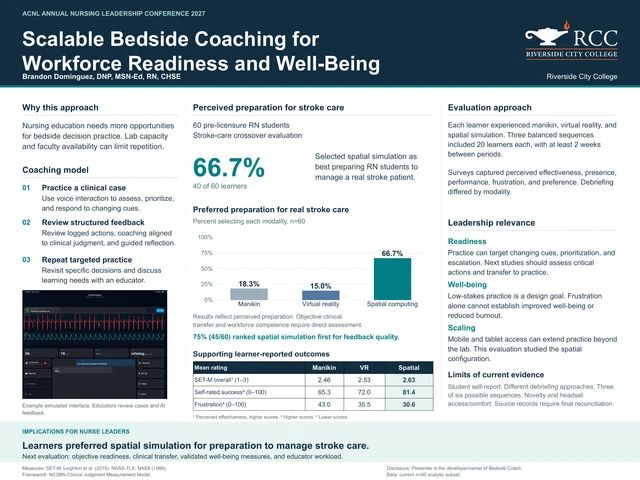
A 60-student crossover evaluation explored how learners perceived preparation for real stroke care across manikin, virtual reality, and spatial simulation.
What this result means: This is a measure of perceived preparation. It does not establish demonstrated clinical competence or transfer to practice.
The main finding
Preferred preparation for real stroke care
Learners selected the modality they believed best prepares pre-licensure RN students for managing a real stroke patient in clinical practice.
Percent selecting each modality as best preparing RN students to manage a real stroke patient; n=60. The bars show learner selections, not measured clinical performance.
Feedback was another area learners valued
75% (45/60)
45 of 60 learners (75%) ranked spatial simulation first for feedback quality.
This is a learner ranking. It is not an objective audit of feedback quality.
How the evaluation worked
The current analysis includes 60 pre-licensure RN students. Each learner experienced high-fidelity manikin, virtual reality, and spatial simulation. Three balanced modality sequences included 20 learners each, with at least two weeks between periods. Debriefing differed by modality.
The spatial condition used Apple Vision Pro with Bedside Coach. These findings apply to that study configuration; mobile and tablet delivery were not evaluated in this comparison.
| Measure | Manikin (high-fidelity manikin) | VR (virtual reality) | Spatial (spatial simulation) |
|---|---|---|---|
| Perceived simulation effectiveness (SET-M overall)1-3; higher ratings | 2.46 | 2.53 | 2.63 |
| Self-rated success0-100; higher ratings | 65.3 | 72.0 | 81.4 |
| Frustration0-100; lower ratings | 43.0 | 35.5 | 30.6 |
Self-rated success is not objective clinical performance. Frustration alone cannot establish a change in well-being.
Why this matters for readiness
For nursing educators and leaders, the findings support further evaluation of spatial simulation as an adjunct to clinical preparation. The next step is to measure critical actions and transfer to practice, alongside validated well-being measures and educator workload.
How to interpret the findings
- Outcomes reflect learner perceptions and self-ratings, rather than a uniform objective assessment of clinical performance.
- Debriefing differed by modality, so the comparison cannot isolate the effect of coaching alone.
- Three of the six possible modality sequences were used. Novelty and headset comfort may influence learner ratings.
- This analysis does not establish improved well-being, reduced burnout, better retention, lower cost, or reduced faculty workload.
- Findings are preliminary. Source records require final reconciliation.
Disclosure: Brandon Dominguez is the developer and owner of Bedside Coach.
Read the poster
Explore the full study summary
View the study approach, learner-reported outcomes, and implications for nurse leaders.
PDF, 48 x 36 inches. Print at 100% / Actual Size.